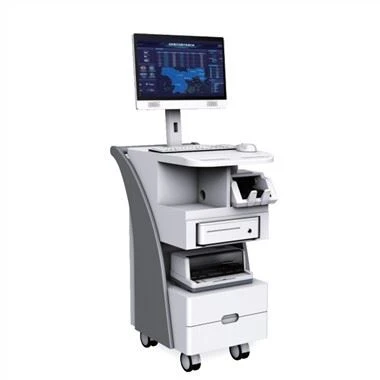
With the development of the times, the display has also started to have touch control functions. Without the mouse and keyboard, it has become more convenient. In industrial production, if the display is equipped with a touch, the operation becomes easier and more convenient, which makes the production more convenient. High efficiency, better job completion, then in industrial production, in addition to improving work efficiency, we also need to consider the touch stability of industrial displays. So today, I will introduce the difference between industrial display capacitive screens and resistive screens. Which is more suitable for industrial production?
Industrial display
Home page, we introduce the resistive screen:
Resistive touch screen is a sensor that converts the physical position of the touch point (X, Y) in a rectangular area into voltages representing X and Y coordinates. Many LCD modules use resistive touch screens. This screen can use four, five, seven or eight lines to generate screen bias voltage and read back the voltage at the touch point.
The advantages of using resistive screens in industrial displays:
1. The resistive touch screen has high accuracy, which can reach the level of pixels, and the maximum applicable resolution can reach 4096x4096.
2. The screen is not affected by dust, water vapor and oil, and can be used in a lower or higher temperature environment.
3. The resistive touch screen uses pressure sensing, which can be touched with any object, even with gloves, and can be used for handwriting recognition.
4. Resistive touch screens are relatively cheap due to mature technology and low threshold.
The disadvantages of using resistive screens in industrial displays:
1. The resistive touch screen can be designed to be multi-touch, but when two points are pressed at the same time, the pressure on the screen becomes unbalanced, resulting in errors in touch, so it is difficult to achieve multi-touch.
2, the resistive screen is easy to turn yellow;
3, the light transmittance of the resistive screen is not as good as that of the capacitive screen;
4. The soft screen needs a certain amount of deformation. For the occasions that are easy to touch, it is easy to break the screen. It is said that there is a very strong material on the surface of the capacitive screen, which can support certain blows without any problem.
Capacitive touch screen:
Capacitive screens need to realize multi-touch by increasing the electrodes of mutual capacitance. Simply put, the screen is divided into blocks, and a set of mutual capacitance modules in each area work independently, so the capacitive screen can be independent The touch condition of each area is detected, and after processing, multi-touch is simply realized.
The advantages of using capacitive screens in industrial displays:
1. The capacitive touch screen only needs touch, not pressure to generate signals.
2, the capacitive touch screen only needs one time or no calibration at all after production, while the resistance technology requires conventional calibration.
3. The life of the capacitive screen is longer, and the parts in the capacitive touch screen do not need any movement. In resistive touch screens, the upper ITO film needs to be thin enough to be flexible so that it can bend downward to contact the lower ITO film.
4. Capacitance technology is superior to resistance technology in terms of light loss and system power consumption.
5. The choice between capacitive technology or resistive technology mainly depends on the object that touches the screen. If it is touched by a finger, a capacitive touch screen is a better choice. If you need a stylus, whether it is plastic or metal, a resistive touch screen can do the job. The capacitive touch screen can also use a stylus, but it needs a special stylus to cooperate.
6. The surface capacitive type can be used for large-size touch screens, and the relative content is relatively low, but it cannot support gesture recognition nowadays: the inductive capacitive type is mainly used for small and medium-sized touch screens, and can support gesture recognition.
7. Capacitive technology is wear-resistant, has a long life, and the user has low maintenance costs when using it. Therefore, the overall cost of the manufacturer can be further reduced.
8. Capacitive touch screens can support multi-touch technology, and unlike resistive touch screens, the response is slow and not easy to wear.
The disadvantages of using capacitive screens in industrial displays:
1. Operators in the industrial control industry generally wear gloves, and it is obviously not appropriate to frequently take off their gloves to operate the capacitive screen.
2. Capacitive screens are more susceptible to the effects of temperature, humidity, electromagnetic interference and other environments. This is obviously not suitable for industrial control where the working environment is relatively harsh.
3. Capacitive screens are relatively expensive at present, especially for capacitive screens that support features such as multi-touch, the price is still a lot more expensive.
Looking at the introduction above, should the industrial display choose the capacitive screen or the resistive screen for the touch function?